Showing posts with label Gold. Show all posts

Sunday, 6 February 2011

Gold Mining Methods

Gold Mining Methods
Placer mining[edit] PanningGold panning is mostly a manual technique of sorting gold. Wide, shallow pans are filled with sand and gravel that may contain gold. The pan is submerged in water and shaken, sorting the gold from the gravel and other material. As gold is much denser than rock, it quickly settles to the bottom of the pan. The panning material is usually removed from stream beds, often at the inside turn in the stream, or resting on the bedrock bed of the stream, where the density of gold allows it to concentrate. This type of gold found in streams or dry streams are called placer deposits.

Gold in goldpan, AlaskaGold panning is the easiest technique for searching for gold, but is not commercially viable for extracting gold from large deposits, except where labor costs are very low and/or gold traces are very substantial. It is often marketed as a tourist attraction on former goldfields. Before production methods can be used, a new source must be identified. Panning is a good way to identify placer gold deposits so that they may be evaluated for commercial viability.
[edit] Sluicing
Gold sluicing at Dilban Town, East Coast, New Zealand, 1880s
Taking gold out of a sluice box, western North America, 1900s.Using a sluice box to extract gold from placer deposits has been a common practice in prospecting and small-scale mining throughout history to the modern day. A sluice box is essentially a man-made channel with riffles set in the bottom. The riffles are designed to create dead zones in the current to allow gold to drop out of suspension. The box is placed in the stream to channel water flow. Gold-bearing material is placed at the top of the box. The material is carried by the current through the box where gold and other dense material settles out behind the riffles. Less dense material flows out of the box as tailings.
Larger commercial placer mining operations employ screening plants, or trommels, to remove the larger alluvial materials, such as boulders and gravel, before concentrating the remainder in a sluice box or jig plant. These operations typically include diesel-powered, earth-moving equipment, including excavators, bulldozers, wheel loaders and rock trucks.

Wednesday, 2 February 2011

Gold Characteristics

Gold is the most malleable and ductile of all metals; a single gram can be beaten into a sheet of 1 square meter, or an ounce into 300 square feet. Gold leaf can be beaten thin enough to become translucent. The transmitted light appears greenish blue, because gold strongly reflects yellow and red.[2] Such semi-transparent sheets also strongly reflect infrared light, making them useful as infrared (radiant heat) shields in visors of heat-resistant suits, and in sun-visors for spacesuits.[3]
Gold readily creates alloys with many other metals. These alloys can be produced to modify the hardness and other metallurgical properties, to control melting point or to create exotic colors (see below).[4] Gold is a good conductor of heat and electricity and reflects infrared radiation strongly. Chemically, it is unaffected by air, moisture and most corrosive reagents, and is therefore well suited for use in coins and jewelry and as a protective coating on other, more reactive, metals. However, it is not chemically inert.
Common oxidation states of gold include +1 (gold(I) or aurous compounds) and +3 (gold(III) or auric compounds). Gold ions in solution are readily reduced and precipitated out as gold metal by adding any other metal as the reducing agent. The added metal is oxidized and dissolves allowing the gold to be displaced from solution and be recovered as a solid precipitate.
High quality pure metallic gold is tasteless and scentless; in keeping with its resistance to corrosion (it is metal ions which confer taste to metals).[5]
In addition, gold is very dense, a cubic meter weighing 19,300 kg. By comparison, the density of lead is 11,340 kg/m3, and that of the densest element, osmium, is 22,610 kg/m3

Gold

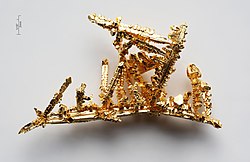
Gold ( /ˈɡoʊld/) is a chemical element with the symbol Au (from Latin: aurum "gold") and an atomic number of 79. It has been a highly sought-after precious metal for coinage, jewelry, and other arts since the beginning of recorded history. The native metal occurs as nuggets or grains in rocks, in veins and in alluvial deposits. Less commonly, it occurs in minerals as gold compounds, usually with tellurium. Gold metal is dense, soft, shiny and the most malleable and ductile pure metal known. Pure gold has a bright yellow color and luster traditionally considered attractive, which it maintains without oxidizing in air or water. Gold is one of the coinage metals and has served as a symbol of wealth and a store of value throughout history. Gold standards have provided a basis for monetary policies. It also has been linked to a variety of symbolisms and ideologies.
A total of 165,000 tonnes of gold have been mined in human history, as of 2009.[1] This is roughly equivalent to 5.3 billion troy ounces or, in terms of volume, about 8,500 m³, or a cube 20.4 m on a side. The world consumption of new gold produced is about 50% in jewelry, 40% in investments, and 10% in industry.
Although primarily used as a store of value, gold has many modern industrial uses including dentistry and electronics. Gold has traditionally found use because of its good resistance to oxidative corrosion and excellent quality as a conductor of electricity.
Chemically, gold is a transition metal. Compared with other metals, pure gold is chemically least reactive, resisting individual acids but being attacked by the acid mixture aqua regia, so named because it dissolves gold. Gold also dissolves in alkaline solutions of cyanide, which have been used in mining. Gold dissolves in mercury, forming amalgam alloys. Gold is insoluble in nitric acid, which dissolves silver and base metals, a property that has long been used to confirm the presence of gold in items, and this is the origin of the colloquial term "acid test", referring to a gold standard test for genuine value.